Up next in 10


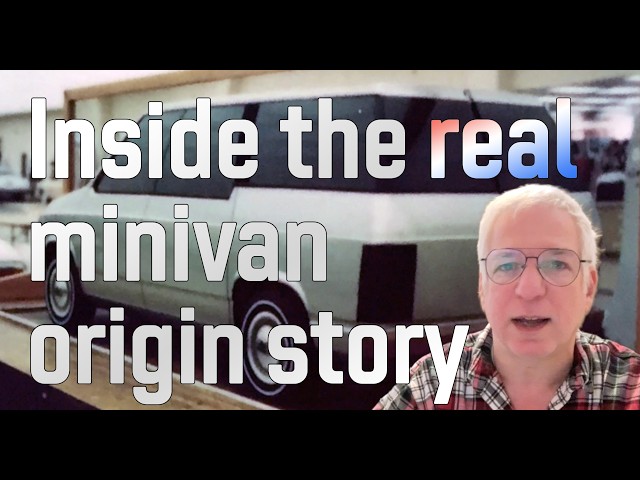
A brief look at why Chrysler started working on (what became) the minivan in 1972, how quickly it got to its final form, and how it was finally approved!
From the writer of “Mopar Minivans.”
#minivan #minivanlife
Show More Show Less View Video Transcript
0:00
Hi there, this is Dave from Motel here
0:02
to set the record straight on the
0:04
creation of the minivan. And there is
0:06
two stories that go around that are pure
0:08
myth. And one of them is that House
0:10
Berlick took the minivan work that was
0:12
going on at Ford over to Chrysler. The
0:14
other one is that Leakoka took the Ford
0:17
carousel minivan project again over to
0:20
Chrysler. But I have to say one thing,
0:22
which is that if Aayakoka had thought
0:24
minivans were great when he saw the
0:26
carousel project, he could have approved
0:28
it at Ford.
0:30
So what actually happened? Years ago, I
0:34
saw some photos that Milt Antine had
0:36
taken of various clays and they had
0:39
started around 1972 in design with the
0:43
idea that the custom van craze could
0:46
somehow be adapted into factory
0:48
vehicles. But then they quickly started
0:50
getting into the question of well what
0:52
would it take to really sell these to
0:54
the average person? And at the same
0:56
time, product planners were looking at
0:58
an evolution of the station wagon. And
1:00
they ended up meeting in the same place
1:02
around 197374
1:05
and working together on this. And some
1:08
of the things that they realized was
1:09
that one, one of the big problems with
1:12
their current commercial vans, if you're
1:14
trying to sell them to regular people,
1:15
is that the engine was sitting right
1:17
next to you as the driver. So, there was
1:20
this thermally and acoustically
1:23
insulated cover and underneath that was
1:25
most of your engine
1:27
and that obviously brought heat and
1:29
noise in and was not ideal. Another one
1:32
was you couldn't stick it into your
1:34
garage. It was just too big for almost
1:36
any garage to have a B van. So, they had
1:39
to figure out a way to move the engine
1:41
forward and have this area empty. a nice
1:44
flat loading floor which hopefully you
1:47
could put a 4x8 sheet of plywood into.
1:49
That was one of the original goals that
1:51
they didn't reach for quite a while. So
1:53
man, uh so I talked with Bert Boamp who
1:56
is one of the product planning people
1:58
and he uh gave credit to Owen Keeler and
2:01
Jean Jacobe among others and supporting
2:04
the idea and conducting market research
2:06
in the early 1970s. So, we're probably
2:09
talking 7374.
2:11
And then designers started uh doing
2:14
clays for how you would style it if you
2:16
were going to make it and seating bucks
2:18
to have ideas for the interior. So, four
2:21
problems. Number one, $und00 million
2:24
worth of special tooling would be needed
2:26
in the mid70s. So, that's an enormous
2:28
startup cost for risky design. Uh
2:32
really, you wanted front-wheel drive for
2:34
this vehicle just like in the ProMaster.
2:37
The idea is that it's either going to be
2:38
really tall off the ground if you want
2:41
that flat floor inside or it's going to
2:43
be frontwheel drive so that there's no
2:45
drive shaft. They didn't have a small
2:47
enough engine. They did have the slant
2:49
6, but it was both too big and not
2:52
powerful enough.
2:54
And finally, it conflicted with their
2:57
overall product strategy, which believe
2:59
it or not at that time was if GM or Ford
3:02
makes it, we'll make it too with the
3:05
exception of the Corvette and the
3:06
Thunderbird. Now, House Berlick uh came
3:09
in from Ford and he championed the idea
3:11
that was already growing at Chrysler and
3:14
he found the funding to keep the
3:16
development going. Uh but when Leakoko
3:19
reviewed all the projects in late 1979
3:22
when he came in from Ford, he rejected
3:25
the minivan because by this point it was
3:27
estimated to cost $700 million to do the
3:30
engineering work and get it into
3:32
production. Now what happened was that
3:34
House Berlock talked to him after the uh
3:36
big planning meeting where he went
3:37
through and thumbs up or thumb down all
3:39
the projects and he decided okay we're
3:42
going to do this. Now, one reason why
3:45
Aayakoka might have approved the minivan
3:48
was because Chrysler had already started
3:51
on the replacement for the olari, which
3:54
was the Plymouth Realigned and Dodge
3:56
Aries, the K cars, and that provided
3:58
them with a full chassis that they could
4:00
adapt. And indeed, the work to create
4:03
those new front-wheel drive cars
4:06
practically bankrupted the company. But
4:08
in any case, uh they they went ahead
4:11
with the minivans with Aayakoka support.
4:14
Uh they had some key decisions to still
4:16
be made, including the sliding door that
4:19
House Berlick made the final decision on
4:21
that and that turned out to be a major
4:23
advantage for getting people and cargo
4:25
into the van. They originally wanted two
4:27
sliding doors, but the budget and the
4:30
stiffness of the body did not make that
4:32
possible yet. A sliding door is a big
4:35
deal from a body stiffness perspective
4:37
because it's this great big hole
4:38
basically. Now, the minivan was pretty
4:41
much an instant hit and it commanded
4:43
premium pricing in the early days and I
4:46
am told that the profit ran to $5,000
4:50
per vehicle which is just incredible.
4:55
So to give full credit to Ford though,
4:57
that just seems unfair to the many
4:59
people who stuck by this project and put
5:02
their heart and soul into it and got
5:04
something that really worked well. And
5:07
it was such a success that, you know, it
5:09
came out in 1983 as a 1984 model and
5:13
they had so much part sharing in it
5:15
because they didn't know if it would
5:16
work. It was a big gamble. So they
5:17
couldn't invest too much money into it.
5:20
So if you had one that was made 84 to 90
5:23
and you saw the inter the interior of a
5:26
Plymouth 3 line, you could see the part
5:28
sharing. It was very visible and it
5:30
wasn't a great feeling vehicle really.
5:32
But then for 91, they had a much larger
5:34
budget and they made it feel like a
5:36
luxury car for the time. It was really
5:39
pretty incredible. So here's to all the
5:42
people who worked on those minivans and
5:45
got them going at Chrysler.
5:48
for more by the book. I also get into
5:51
how the second generation and the third
5:53
generation were made. Lots of stories
5:54
here from the people who were there. I
5:57
think it's probably the uh most fun book
6:01
that I've done in the stories. Although
6:04
the Viper book was actually pretty fun,
6:06
too. The development of the early Viper
6:08
was just a very fertile ground for fun
6:10
stories. So, that's it for me. I'll see
6:12
you soon.
#Online Video
#Autos & Vehicles
#Automotive Industry
#Other